Search CPCs after Google’s August 2026 bidding update
We analysed 13 weeks of Equeco campaign data after Google’s August bidding update. Search CPCs rose temporarily, without a broad loss of impression share.
Google began rolling out an important target-based bidding update on 17 August 2026 and completed the rollout on 27 August.
The change moved budget-limited campaigns that were meaningfully outperforming their cost per acquisition (CPA) or return on ad spend (ROAS) targets closer to those levels, increasing CPA or reducing ROAS. For example, a campaign achieving a $5 CPA against a $10 target would move closer to $10.
Advertisers retained control over campaign budgets and bidding targets.
The update concerned us, not just for the affected campaigns, but for other advertisers too. We had a hunch that more aggressive bidding by budget-constrained campaigns could make shared auctions more expensive.
To investigate, we analysed 13 weeks of data across thousands of campaigns in Equeco accounts, primarily in travel, retail and B2B. We looked for two signs: more campaigns with large weekly increases in cost per click (CPC), and a broad decline in Search impression share. We also checked whether any CPC increase lasted.
As it turns out, the evidence suggests the CPC increase was short-lived. Here are our findings.
Search CPCs rose temporarily, then returned close to baseline
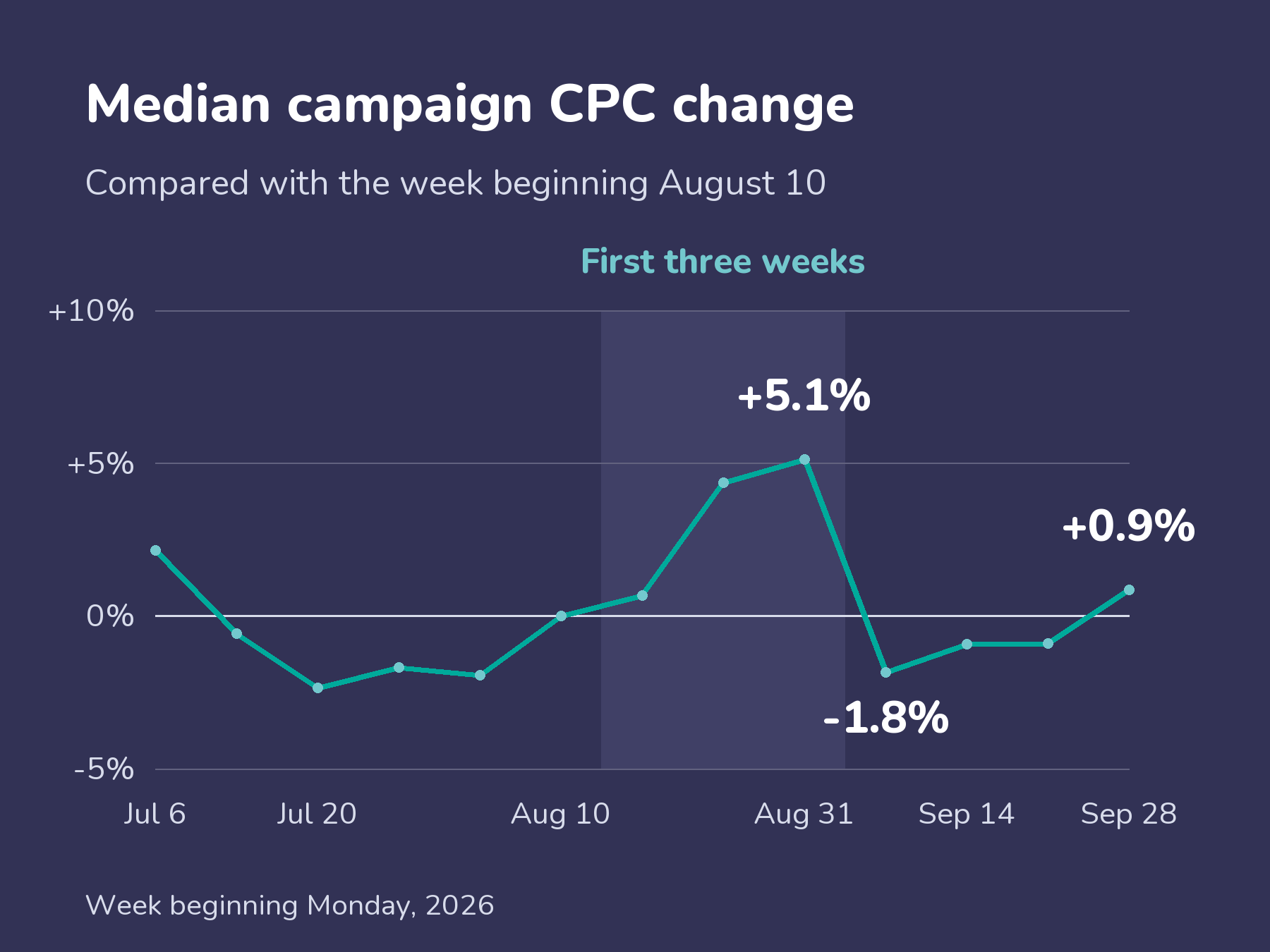
Compared with the week beginning 10 August, median campaign CPC peaked at +5.1% in the week beginning 31 August, showing an initial rise around the rollout.
However, it then fell below that baseline in early September. In the final observed week, beginning 28 September, the median change was only +0.9%, close to baseline. We therefore found no sign of a lasting CPC increase in the campaigns we analysed.
Figure 1. Median Search campaign CPC change relative to the week beginning 10 August 2026. The shaded area spans the rollout and its immediate aftermath.
Note: Each point shows the median campaign CPC change compared with the week beginning 10 August. Campaigns needed clicks in both weeks, so the sample varies.
Large weekly CPC increases became more common initially
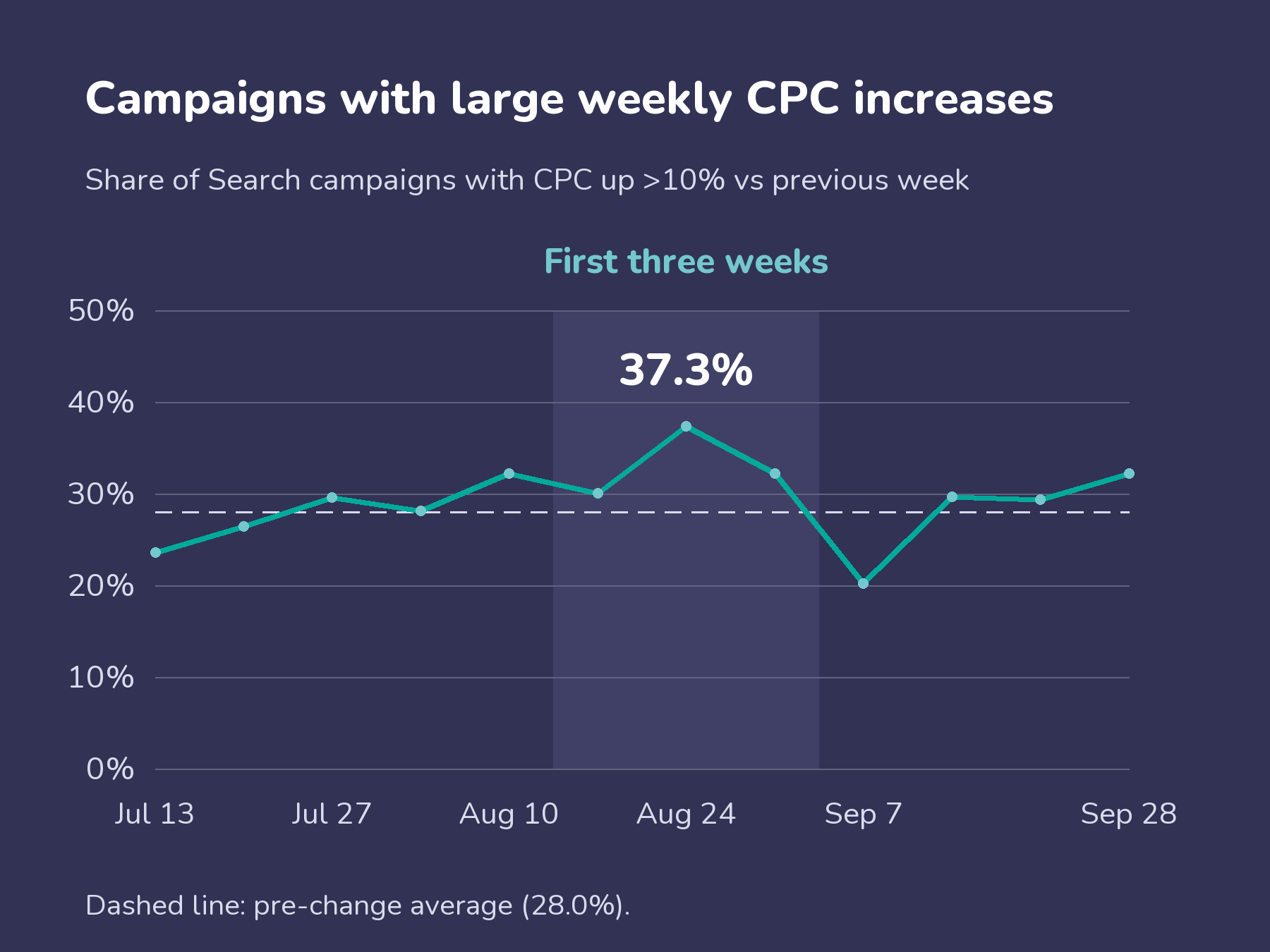
We also checked whether large CPC increases became more widespread. The average weekly share of campaigns with increases above 10% rose from 28.0% before the update to 33.2% during the rollout and its immediate aftermath, an increase of 5.2 percentage points.
The peak was 37.3% in the week beginning 24 August. This shows that large CPC increases were more common around the rollout, but the return towards baseline in Figure 1 shows that the rise in median CPC did not last.
Figure 2. Share of comparable Search campaigns with a CPC increase greater than 10% versus the previous week. Percentages describe the share of campaigns, not the size of the CPC increase.
The trend had already begun before the rollout, possibly because advertisers adjusted their campaign settings in advance. We cannot tell whether that happened from these data.
Impression share did not show the broad decline we expected
We also checked Search impression share, the proportion of eligible impressions a campaign received. A broad decline could be a sign of greater competition.
Google reports some low impression-share readings as “below 10%”. We therefore used Search campaigns with reported impression share above 10% in all 13 weeks for the main comparison.
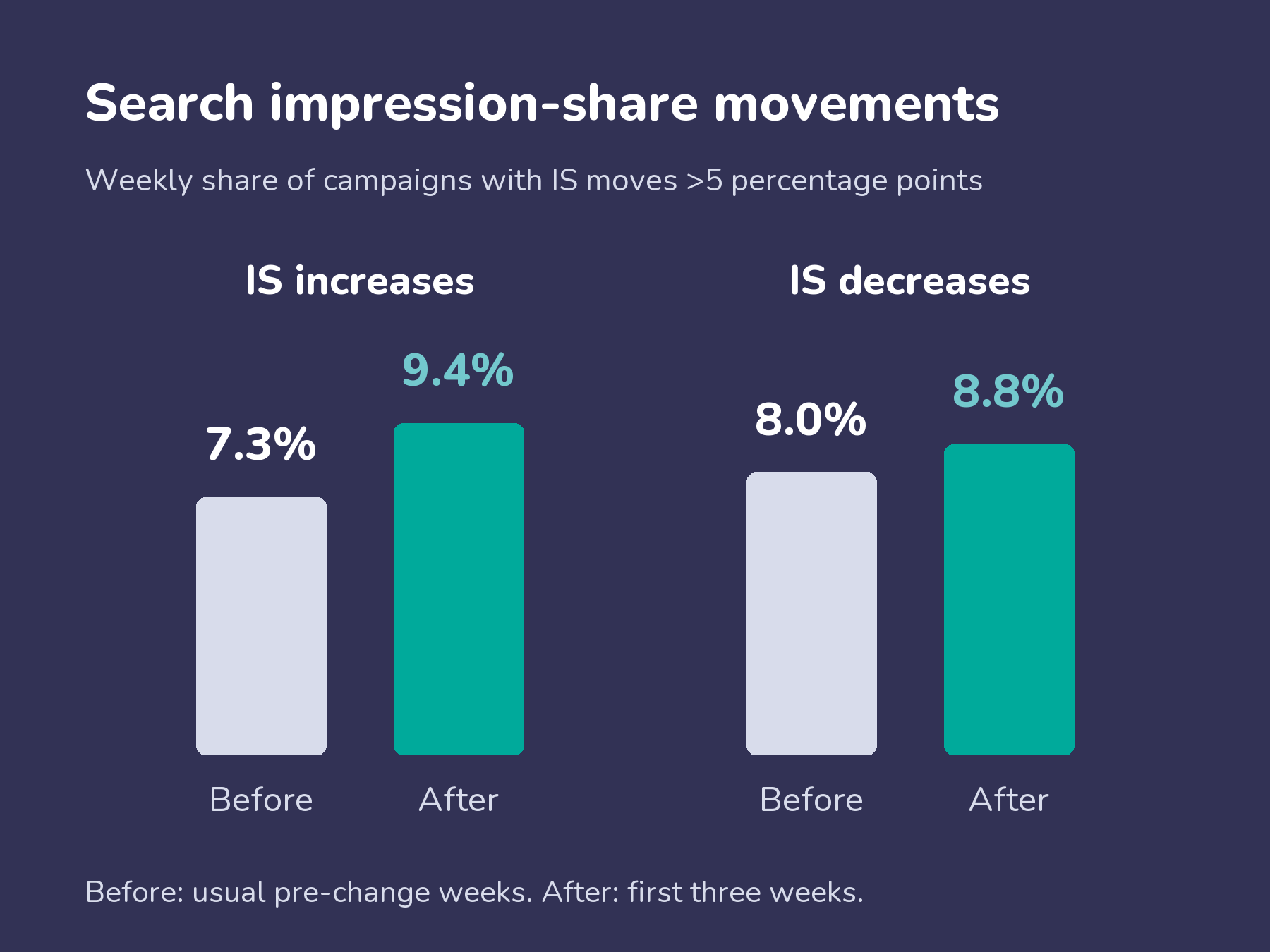
The average weekly share of campaigns losing more than five percentage points of impression share rose only slightly, from 8.0% to 8.8%. Meanwhile, the share gaining that much rose from 7.3% to 9.4%.
Figure 3. Average weekly share of campaigns with Search impression-share movements greater than five percentage points, comparing pre-change weeks with 17 August to 6 September.
These measures did not suggest that campaigns were broadly being squeezed out of auctions.
Requiring impression share above 10% throughout could exclude campaigns whose visibility fell sharply after the update. We therefore repeated the comparison using only pre-update readings to select campaigns. The result was similar, suggesting the filter was not hiding a broad decline. Later below-10% and missing readings were tracked separately.
What we conclude
Search CPCs rose temporarily, then returned close to their pre-update baseline. We also found no broad loss of Search impression share during the initial three-week period. Based on these findings, we cannot conclude that Google’s bidding change made its auctions more competitive.
A comment on our LinkedIn analysis offered another possibility: campaigns bidding more aggressively might use their budgets earlier, leaving more opportunities for other advertisers later in the day. That could change when competition occurs without making auctions consistently more expensive. Our weekly data cannot tell us whether this happened.
The results do not rule out effects on individual campaigns or markets, and the comparison cannot isolate the update’s effect. For advertisers interpreting their campaign performance, our findings do not support assuming that the update created lasting, widespread auction pressure.
How we ran the comparison
Period: 6 July to 4 October 2026, covering 13 complete Monday-to-Sunday weeks.
Campaigns: We selected campaigns with consistent volume before the update. Accounts primarily covered travel, retail and B2B. We analysed Search and Performance Max separately; this article focuses on Search. The CPC and impression-share analyses used different subsets.
Weekly comparisons: Five weekly transitions before the rollout, the first three weeks from its start, and four later weeks to check whether changes lasted.
CPC baseline: The week beginning 10 August. We calculated each campaign’s percentage change against its own CPC in that week, then took the median. These are campaign-level results, not spend-weighted CPC changes. We did not compound weekly median changes.
Impression-share comparison: We calculated the weekly share of campaigns with increases or decreases greater than five percentage points, then compared the average shares before the rollout with those from 17 August to 6 September. The main sample had reported impression share above 10% in all 13 weeks; we also checked a sample selected using only pre-update readings.
Limits: We could not identify which campaigns had qualified for the update, so we could not directly compare affected and unaffected campaigns. The short pre-update history and routine changes to budgets, targeting and auction eligibility also limit what we can conclude. This comparison cannot isolate the update’s effect.