March 27, 2026
Alice Zanovello
The “Death of Keywords” Narrative Is Wrong– Here’s Why
Discovery is becoming conversational, but transactions still rely on precise queries.
Request a free audit
Discovery is becoming conversational, but transactions still rely on precise queries.
Request a free auditOver the past year, the idea that AI will replace search has become increasingly prevalent, strongly reinforced by Google Ads teams.
In reality, the shift is more nuanced.
Over the next two years, search is unlikely to move away from keywords entirely. Instead, it is evolving into a hybrid model where AI helps interpret intent, while keywords continue to signal it.
Search behavior is not being replaced. It is becoming more diverse.
Today, we see two distinct types of queries.
Exploratory queries, such as:
- when to travel to Japan
- best things to do in Hong Kong
And transactional queries, such as:
- train Milan Rome
- car rental Barcelona airport
The difference is not just format. It is intent.
Exploratory searches reflect users who are still gathering information. Transactional searches indicate users who already know what they want and are closer to making a decision.
With the rise of conversational AI, exploratory queries are increasingly expressed as full questions. This is where AI adds the most value.
AI can not only surface information, but also organize it. It can suggest options, structure recommendations, or even build itineraries. This goes beyond traditional search, which requires users to navigate multiple sources.
However, once intent becomes clear, behavior shifts back to short, direct queries.
This is where traditional search remains dominant.
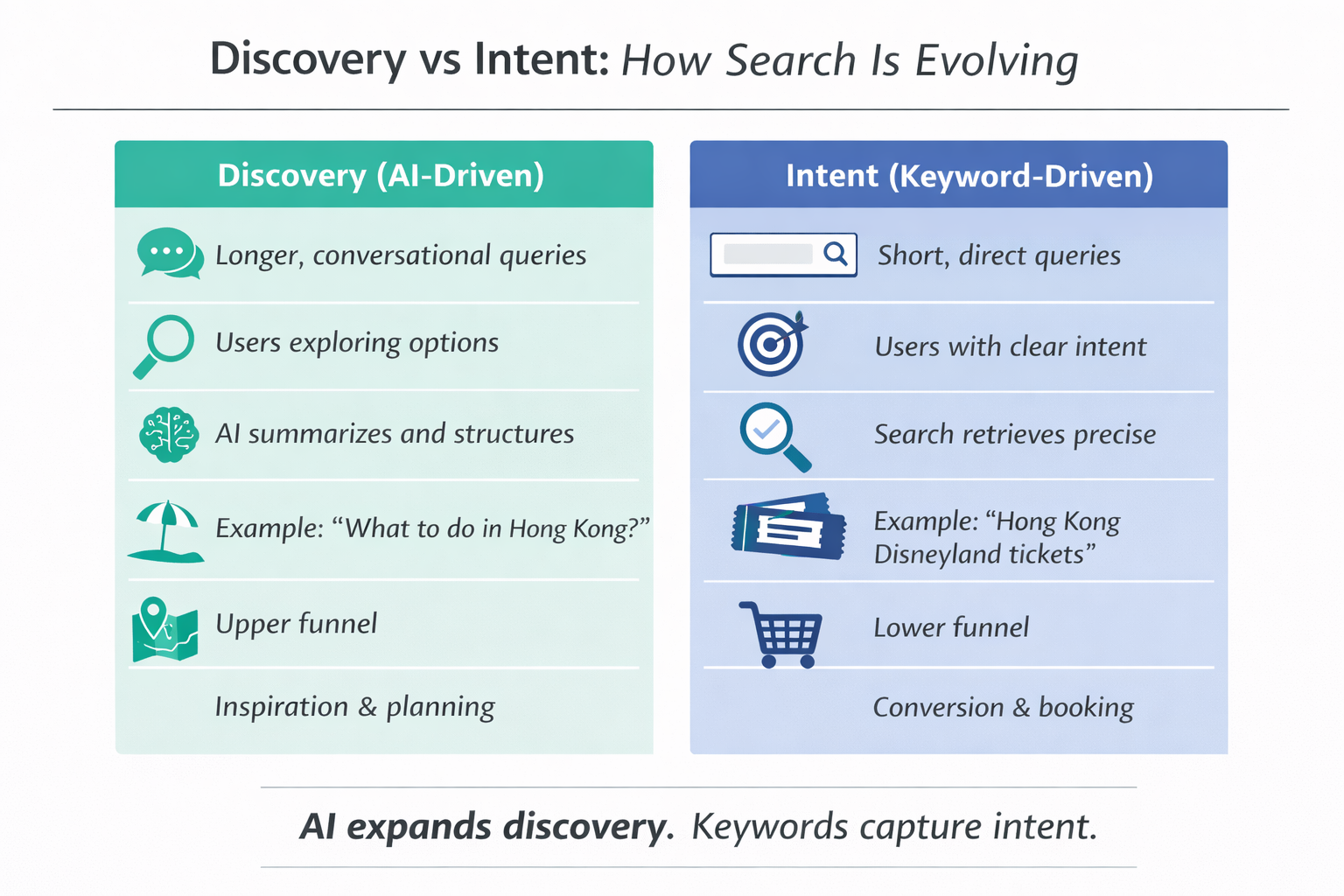
Despite the growth of AI-driven interfaces, most monetized search activity still originates from traditional keyword queries.
This is particularly true in transactional verticals such as travel, services, ecommerce, and software.
These queries are extremely efficient. They communicate a precise need and typically sit at the lower end of the funnel, where users are closer to purchasing. As a result, they tend to drive higher conversion rates and capture a significant share of performance-driven budgets.
At the same time, Google’s advertising solutions within AI results are still evolving. Measurement remains limited, and performance from AI surfaces is not clearly separated from traditional search.
This reinforces the role of keyword-based search as the primary and most measurable driver of commercial performance today.
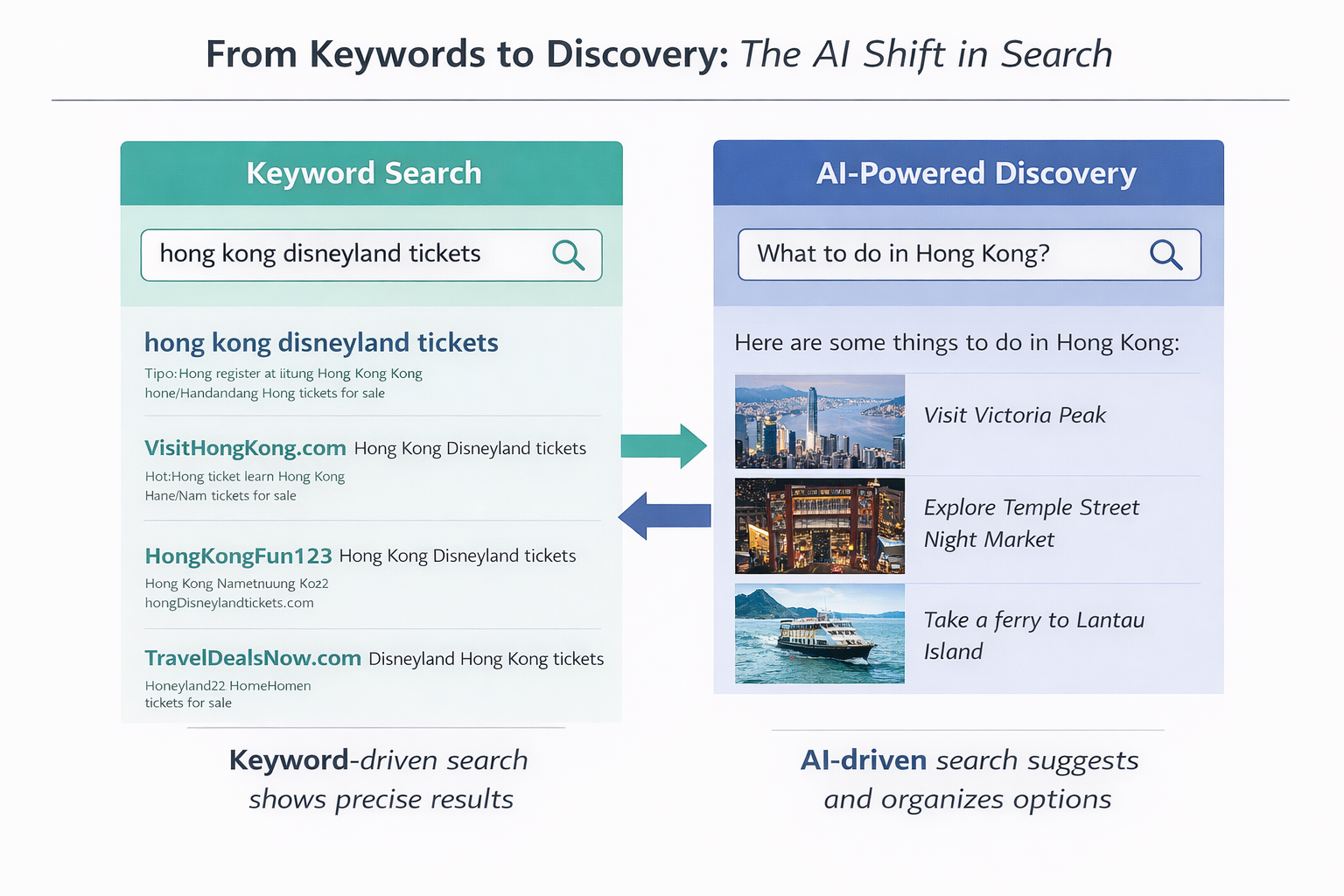
Search platforms are not moving away from traditional search. They are expanding it.
AI is being used to unlock incremental search volume, especially in exploratory use cases. At the same time, high-intent queries remain central to monetization.
From a product perspective, this is reflected in the coexistence of fully AI-driven experiences and hybrid formats within search results.
This allows platforms to scale AI adoption while maintaining control over volume, experience, and advertising performance.
Even in AI-driven environments, strong signals remain essential. Keywords continue to play a key role in defining intent and enabling relevance.
For advertisers and paid media teams, the implication is clear.
AI does not require a complete overhaul of Google Ads strategies. A significant share of traffic still comes from traditional search, and keyword-based structures remain essential.
At the same time, AI-driven systems continue to rely on these signals to interpret intent and match ads to queries.
Effective strategies should focus on two priorities.
First, protecting coverage on high-intent keywords, which remain the main driver of performance.
Second, adapting creative and content to participate in AI-driven discovery environments, where users are exploring options.
Search is not disappearing. It is evolving to coexist with AI.
Keywords will continue to capture a significant share of commercial demand across transactional verticals, including travel, services, ecommerce, and software.
At the same time, AI will support discovery, help users explore options, and increasingly take action by organizing and structuring information.
The most effective strategies will recognize that this is not a replacement, but an expansion of the same system.
Keywords remain the clearest signal of intent, while AI builds on top of that signal to interpret and expand it.